


Effectiveness
The evaluation of the effectiveness of livestock guardian dogs is generally carried out according to three criteria:
- Evolution of the number of losses;
- Behavior of the livestock guardian dog;
- And owner satisfaction.
Behavioral data are used to complement the evaluation, since the annual evolution of the number of losses can be influenced by many factors external to the quality of the dog. Owner satisfaction with the performance of their dogs is also an important criterion for evaluating the success of this protection method, since their assessment may differ from that made by the technicians. Livestock guardian dogs should only be evaluated after they reach maturity (18‑24 months of age), as before this point the dog should not be expected to effectively defend the herd.
Despite their high effectiveness, the use of quality livestock guardian dogs may not completely prevent predation, making it important to combine them with other complementary protection methods to achieve better results. Furthermore, in certain situations, livestock guardian dogs may not be the most effective method. The selection of methods to be used must take into account their suitability to the existing conditions, namely the type of grazing and pasture, the species and density of the predator, and the size and species/breed of the herd.
Analysis of losses
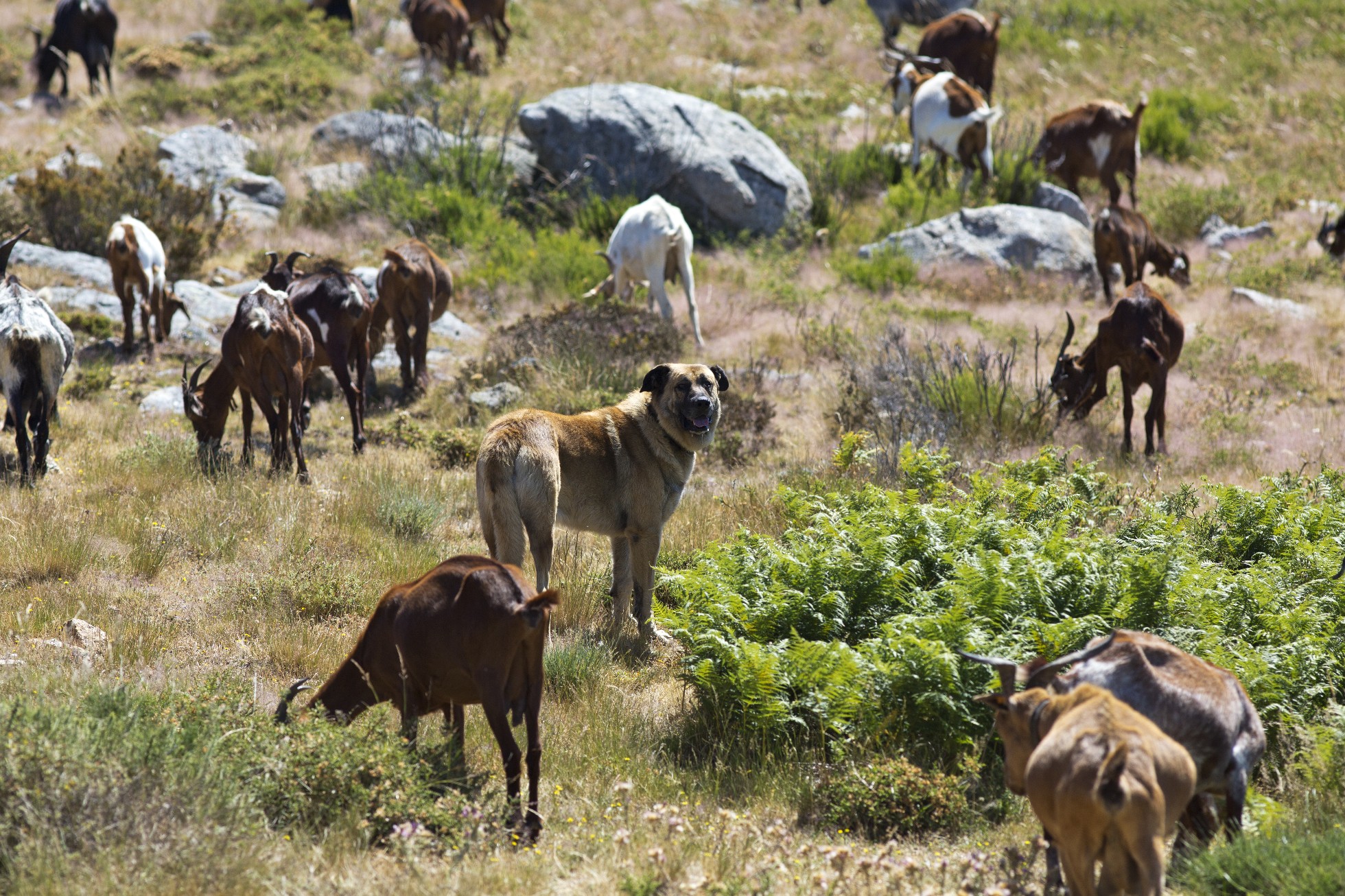
Data relating to 40 livestock guardian dogs of the Castro Laboreiro and Serra da Estrela short‑haired breeds, integrated into small ruminant herds in the North and Central regions of the country, indicate that one year after the dogs were integrated into the herds, the number of losses decreased in 75% of cases and remained stable in 7.5%. The dogs were always considered responsible for the observed decrease in losses, which ranged from 13% to 100%. Even in cases where the number of losses did not remain stable or increased, the dogs were considered responsible for reducing potential losses (taking into account predation recorded in neighboring herds) (Ribeiro & Petrucci‑Fonseca, 2005).
In surveys conducted among 70 livestock farmers using livestock guardian dogs, from 16 states in the United States of America and 2 provinces in Canada, 89% of respondents considered their dogs, belonging to 5 breeds (Komondor, Pyrenean Mountain Dog, Anatolian Shepherd Dog, Akbash and Yugoslav Shepherd Dog), as an economic asset (Green et al., 1984).
In a survey of 119 cattle ranchers in Colorado (United States of America), those who owned livestock guardian dogs (mostly belonging to the Akbash, Komondor, Pyrenean Mountain Dog and Maremma Sheepdog breeds) lost a smaller proportion of sheep and lambs due to predation than ranchers without dogs (Andelt, 1992).
In another survey conducted among 217 livestock farmers in the United States of America, owners of adult livestock dogs (Maremmano‑Abruzzese Shepherd Dog, Anatolian Shepherd Dog and Yugoslav Shepherd Dog), 77% reported a reduction in predation within the year after the dog's introduction, while 43% reported no predation or changes (Coppinger et al., 1988).
When comparing national data with those previously mentioned, it is necessary to consider that in the United States of America the main predator is the coyote, a canid smaller than the wolf, which rarely forms groups larger than the breeding pair. Coyote attacks are generally carried out by one or two individuals, considerably smaller than a livestock guardian dog, which facilitates the protection of herds, compared to an attack carried out by either a wolf or a pack.
Behavioral Records
Based on observation of the dogs during herding and courtship with the flock, it was possible to evaluate 63 adult dogs, mostly belonging to the Castro Laboreiro and Serra da Estrela short-haired breeds. According to the results obtained, 92% of the dogs demonstrated Good-Excellent behavior in the Attention component, 98% in the Trust component, and 90% in the Protection component (Ribeiro & Petrucci-Fonseca, 2005).
There is not much other data resulting from the scientific recording of behavior based on observation of dogs while herding flocks. It is worth highlighting a study conducted in Italy with 33 Maremma Sheepdogs on attention behavior. In this study, only about 50% of the dogs observed demonstrated good-excellent attention (Coppinger et al., 1983).
Surveys of owners
In terms of performance, of the 40 adult Castro Laboreiro and Serra da Estrela short-haired dogs evaluated by their owners, 90% were considered Good-Excellent and none were considered Poor. Regarding behavioral components, 80% of the dogs were considered Good-Excellent in Attention, 98% in Confidence, and 92% in Protection (Ribeiro & Petrucci-Fonseca, 2005).
In a survey conducted in Colorado (United States of America) using livestock guardian dogs (mostly belonging to the Akbash, Komondor, Pyrenean Mountain Dog, and Maremma Sheepdog breeds), 20 out of 22 livestock breeders rated their dogs' performance as Good-Excellent (Andelt, 1992). In another survey conducted in 16 other states and 2 provinces of Canada, owners of 137 livestock guardian dogs belonging to 5 breeds (Komondor, Pyrenean Mountain Dog, Anatolian Shepherd Dog, Akbash, and Yugoslav Shepherd Dog) considered 80% of the dogs to be good guardians (Green et al., 1984).
In a study conducted over 7 years, including 100 livestock guardian dogs belonging to the three most commonly used breeds in the United States (Maremmano-Abruzzese Shepherd Dog, Yugoslav Shepherd Dog, Anatolian Shepherd Dog), and their crosses, the owners' rating of the dogs' Attention, considered Good-Excellent, ranged from 49 to 80% depending on the breed. Regarding Protection behavior, owners rated 74% of the dogs as Good-Excellent. As for Trust, ratings ranged from 40 to almost 90%, depending on the breed, although most were above 80% (Coppinger et al., 1988).
In a study on the performance of dogs integrated into herds in the United States of America, through a qualitative evaluation, different criteria related to the dog's behavior and efficiency, as well as owner satisfaction, were used. Of the 95 adult dogs evaluated (Pyrenean Mountain Dog, Anatolian Shepherd Dog, Akbash and Kuvasz), 66% of the dogs were classified as Good, 14% as Sufficient and 20% as Poor (Green & Woodruff, 1990).
Owner satisfaction
Data collected from the owners of 40 adult livestock guardian dogs of the Castro Laboreiro and Serra da Estrela short‑haired breeds indicate that over 90% of owners are very satisfied with their livestock guardian dogs, requesting additional dogs for the herd. Only one livestock breeder who considered their dog's performance "Sufficient" expressed a desire to replace it with another, while maintaining confidence in the effectiveness of these dogs.